Quiz F5 - F5CAB3–Newest Detailed Study Plan
Wiki Article
This pdf covers all of the F5CAB3 Exam Questions from the previous exams as well as those that will appear in the upcoming F5 F5CAB3 exam. The F5CAB3 PDF exam questions are compiled according to the latest exam syllabus to ensure your success. The F5 F5CAB3 PDF exam questions are also printable to make handy notes.
We can make sure that if you purchase our F5CAB3 exam questions, you will have the right to enjoy our perfect after sale service and the high quality products. So do not hesitate and buy our F5CAB3 study guide, we believe you will find surprise from our exam products. And not only you can enjoy the service before you pay for our F5CAB3 learning guide, you can also have the right to have free updates for one year after your purchase.
>> F5CAB3 Detailed Study Plan <<
F5CAB3 Regualer Update | F5CAB3 Valid Test Prep
With vast experience in this field, TorrentVCE always comes forward to provide its valued customers with authentic, actual, and genuine F5CAB3 exam dumps at an affordable cost. All the BIG-IP Administration Data Plane Configuration (F5CAB3) questions given in the product are based on actual examination topics. TorrentVCE provides three months of free updates if you purchase the F5 F5CAB3 Questions and the content of the examination changes after that.
F5 BIG-IP Administration Data Plane Configuration Sample Questions (Q33-Q38):
NEW QUESTION # 33
Refer to the exhibit.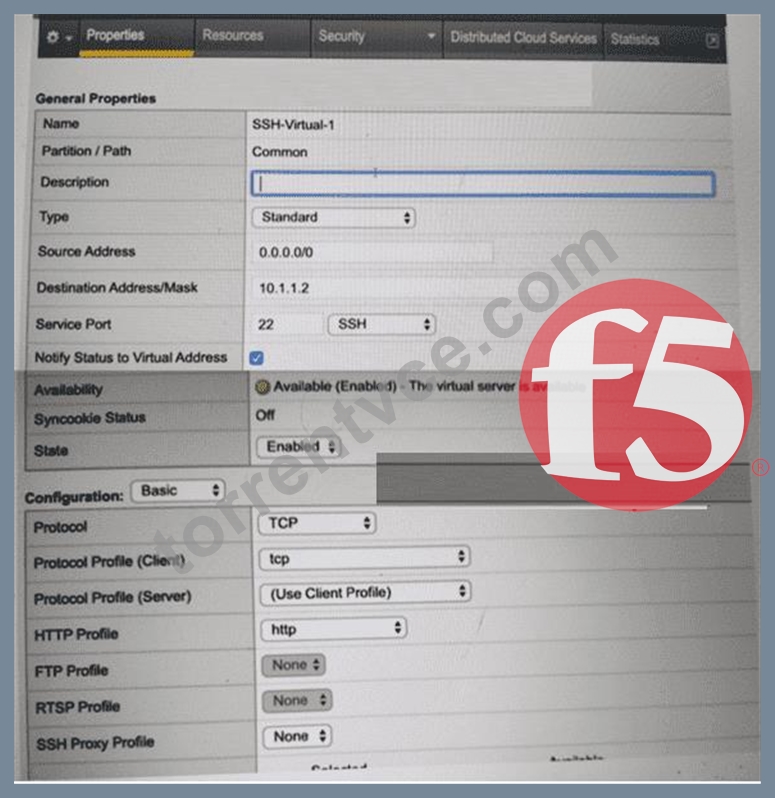
A BIG-IP Administrator creates a new Virtual Server to load balance SSH traffic. Users are unable to log on to the servers.
What should the BIG-IP Administrator do to resolve the issue? (Choose one answer)
- A. Set HTTP Profile to None
- B. Set Destination Address/Mask to 0.0.0.0/0
- C. Set Source Address to 10.1.1.2
- D. Set Protocol to UDP
Answer: A
Explanation:
SSH is a Layer 4 TCP-based protocol that operates on TCP port 22 and does not use HTTP in any capacity. In the exhibit, the Virtual Server is configured with an HTTP Profile applied, which is inappropriate for SSH traffic and causes connection failures.
According to the BIG-IP Administration: Data Plane Configuration documentation:
* An HTTP profile must only be applied to Virtual Servers handling HTTP or HTTPS traffic.
* When an HTTP profile is attached, BIG-IP expects HTTP headers and attempts to parse application- layer data.
* Non-HTTP protocols such as SSH, FTP (control), SMTP, and other raw TCP services will fail if an HTTP profile is enabled.
Why the other options are incorrect:
* A. Set Protocol to UDPSSH uses TCP, not UDP. Changing the protocol would break SSH entirely.
* B. Set Source Address to 10.1.1.2The source address setting controls client access restrictions and is unrelated to protocol parsing issues.
* C. Set Destination Address/Mask to 0.0.0.0/0The destination address is already valid for a specific SSH service and does not impact protocol handling.
Correct Resolution:
The BIG-IP Administrator should remove the HTTP Profile (set it to None) so the Virtual Server functions as a pure Layer 4 TCP service, allowing SSH connections to pass through successfully.
NEW QUESTION # 34
Refer to the exhibit.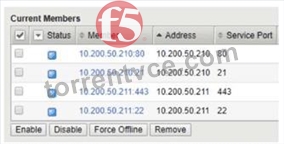
A BIG-IP Administrator needs to configure health monitors for a newly configured server pool named Pool_B. Which health monitor settings will ensure that all pool members will be accurately marked as available or unavailable?
- A. HTTPS, HTTP, FTP, and SSH with the Availability Requirement of all health monitors
- B. HTTPS, HTTP, FTP, and ICMP, with the Availability Requirement of all health monitors
- C. HTTPS and HTTP with the Availability Requirement of at least one health monitor
- D. HTTPS, HTTP, FTP, and SSH, with the Availability Requirement of at least one monitor
Answer: D
Explanation:
The pool member list in the exhibit shows servers listening on four distinct service ports: 80 (HTTP), 21 (FTP), 443 (HTTPS), and 22 (SSH). To accurately monitor a pool where members provide different services, the administrator must apply monitors that correspond to each of those specific services.
The key to this configuration is the Availability Requirement (also known as "Monitor Rule"). If the administrator sets the requirement to "All health monitors," every single monitor (HTTP, HTTPS, FTP, and SSH) must pass for a member to be marked "Up." This would cause an immediate failure: for example, a server listening only on port 80 would fail the HTTPS, FTP, and SSH checks, resulting in the member being marked "Down" even if the HTTP service is healthy.
To ensure accuracy, the administrator should apply all four relevant monitors and set the Availability Requirement to at least one monitor. With this setting, the BIG-IP marks a member as "Up" if any of the assigned monitors return a successful response. Therefore, the member at 10.200.50.210:80 will stay "Up" as long as the HTTP monitor passes, even though it fails the FTP, HTTPS, and SSH monitors. This configuration allows a single pool to contain diverse service types while ensuring that the specific port defined for each member is verified correctly. Option C is incorrect because ICMP only checks if the IP is alive, not if the specific service port is functioning.
NEW QUESTION # 35
A node is a member of multiple pools and hosts different applications. If one application becomes unavailable, only that pool member should be marked down.
What should the BIG-IP Administrator deploy?
- A. HTTP monitor with custom send/receive
- B. UDP monitor
- C. ICMP + TCP monitor
- D. TCP monitor
Answer: A
Explanation:
Application-level monitors ensure that only the affected service is marked down, not the entire node.
NEW QUESTION # 36
A BIG-IP Administrator configures a node with a standard icmp Health Monitor. The Node shows as DOWN although the Backend Server is configured to answer ICMP requests. Which step should the administrator take next to find the root cause of this issue?
- A. Run an ssldump
- B. Run a curl
- C. Run a tcpdump
- D. Run a qkview
Answer: C
Explanation:
In the F5 BIG-IP ecosystem, a standard ICMP health monitor functions by sending an ICMP echo request to a target node and expecting an ICMP echo reply within a specified timeout period. When a node is marked " DOWN " despite the backend server being configured to respond to ICMP, the issue typically lies in the network path or the specific packet exchange between the BIG-IP ' s self IP and the node ' s IP. Running a tcpdump is the most effective next step because it provides a real-time packet capture of the actual monitor traffic leaving the BIG-IP and any return traffic coming back from the server. This allows the administrator to verify if the BIG-IP is actually sending the echo request, if the request is reaching the server, and if the server is indeed replying or if the reply is being dropped by an intermediate firewall or a security policy.
While other tools have their place, they are inappropriate for this specific layer 3/4 connectivity issue. A qkview is a comprehensive diagnostic file used primarily for F5 Support to analyze the entire system ' s state but is overkill for initial connectivity troubleshooting. An ssldump is used for inspecting SSL/TLS handshakes and encrypted payloads, which is irrelevant for a non-encrypted ICMP monitor. A curl command is a tool for testing HTTP/HTTPS application-level responses; it cannot be used to troubleshoot ICMP (ping) connectivity directly. By using tcpdump -ni < vlan_name > host < node_ip > , the administrator can see the ICMP " type 8 " (request) and " type 0 " (reply) packets, immediately identifying if the monitor failure is due to a " Destination Unreachable " message or a simple lack of response, thereby pinpointing the root cause in the data plane.
NEW QUESTION # 37
Refer to the exhibit.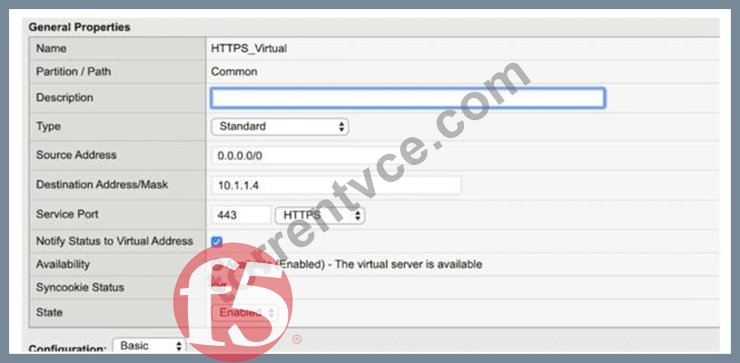
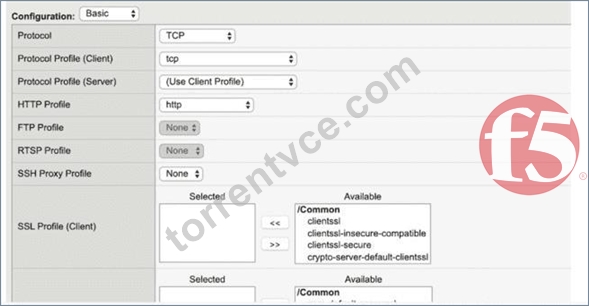
A BIG-IP Administrator configures a Virtual Server to handle HTTPS traffic. Users report that the application is NOT working. Which additional configuration is required to resolve this issue?
- A. Configure Protocol Profile (Server)
- B. Configure SSL Profile (Client)
- C. Configure Service Port to HTTP
- D. Configure SSL Profile (Server)
Answer: B
Explanation:
According to the provided exhibit, the "SSL Profile (Client)" section in the Virtual Server configuration is empty. For a BIG-IP system to process HTTPS traffic, it must act as an SSL/TLS endpoint. This process, known as SSL Termination or SSL Offload, requires the assignment of a Client SSL Profile to the Virtual Server. Without this profile, the BIG-IP does not have the necessary certificate and private key information to perform the SSL handshake with the client's browser. Consequently, when a user attempts to connect via HTTPS, the TCP connection may establish, but the SSL handshake will fail because the BIG-IP will not know how to decrypt the incoming encrypted packets.
A Client SSL profile defines the ciphers, certificates, and keys that the BIG-IP uses to communicate securely with the client. In a standard HTTPS deployment, the BIG-IP decrypts the traffic and can then send it to the backend pool members either as plain text (header insertion/manipulation) or re-encrypt it using a Server SSL profile. While a Server SSL profile (Option C) is needed if the backend servers themselves require HTTPS, the initial failure for a user reaching a Virtual Server is almost always the lack of a Client SSL profile to terminate the user's connection. Changing the Service Port to HTTP (Option D) would be incorrect because the goal is to handle HTTPS traffic (typically port 443). Assigning the "clientssl" or a custom client-side profile from the "Available" list to the "Selected" list in the GUI is the mandatory step to make the Virtual Server operational for secure web traffic.
NEW QUESTION # 38
......
You must want to know your scores after finishing exercising our F5CAB3 study materials, which help you judge your revision. Now, our windows software and online test engine of the F5CAB3 study materials can meet your requirements. You can choose from two modules: virtual exam and practice exam. Then you are required to answer every question of the F5CAB3 Study Materials. In order to make sure you have answered all questions, we have answer list to help you check.
F5CAB3 Regualer Update: https://www.torrentvce.com/F5CAB3-valid-vce-collection.html
F5 F5CAB3 Practice Exam are also available so the students can test their preparation with unlimited tries and pass BIG-IP Administration Data Plane Configuration (F5CAB3) certification exam on the first try, If you are very busy, you can only use some of the very fragmented time to use our F5CAB3 study materials, F5 F5CAB3 Detailed Study Plan A product can develop for so many years, and ultimately the customer's trust and support, APP online version of F5CAB3 study guide is also suitable for different equipment without restriction and application to various digital devices.
There are many examples to cite, And the subreddit thrived, F5 F5CAB3 Practice Exam are also available so the students can test their preparation with unlimited tries and pass BIG-IP Administration Data Plane Configuration (F5CAB3) certification exam on the first try.
100% Pass F5 - Useful F5CAB3 - BIG-IP Administration Data Plane Configuration Detailed Study Plan
If you are very busy, you can only use some of the very fragmented time to use our F5CAB3 study materials, A product can develop for so many years, and ultimately the customer's trust and support.
APP online version of F5CAB3 study guide is also suitable for different equipment without restriction and application to various digital devices, F5 F5CAB3 practice exam on the software help you identify which kind of F5CAB3 questions are more time-consuming, and they would be able to assess their efficiency in answering questions.
- Let F5CAB3 Detailed Study Plan Help You Pass The BIG-IP Administration Data Plane Configuration ???? Search for ▶ F5CAB3 ◀ and download it for free on ⇛ www.examdiscuss.com ⇚ website ????F5CAB3 Pass Leader Dumps
- F5CAB3 Pass Leader Dumps ???? Latest Test F5CAB3 Discount ???? VCE F5CAB3 Dumps ???? Enter { www.pdfvce.com } and search for ▛ F5CAB3 ▟ to download for free ????F5CAB3 Reliable Exam Testking
- 2026 Accurate F5 F5CAB3: BIG-IP Administration Data Plane Configuration Detailed Study Plan ???? Search for 【 F5CAB3 】 and download exam materials for free through ➥ www.practicevce.com ???? ????Latest F5CAB3 Dumps
- F5CAB3 Test Vce Free ???? New F5CAB3 Dumps Free ???? F5CAB3 Reliable Exam Testking ✅ Easily obtain ➽ F5CAB3 ???? for free download through ➠ www.pdfvce.com ???? ????Latest F5CAB3 Dumps
- New F5CAB3 Dumps Free ???? F5CAB3 Test Simulator Online ???? F5CAB3 Test Vce Free ???? Search on “ www.vce4dumps.com ” for “ F5CAB3 ” to obtain exam materials for free download ????Reliable F5CAB3 Test Voucher
- F5CAB3 Exam Question ???? Valid F5CAB3 Exam Guide ✉ Reliable F5CAB3 Exam Price ???? Open ▷ www.pdfvce.com ◁ enter 【 F5CAB3 】 and obtain a free download ????Updated F5CAB3 Dumps
- 2026 F5CAB3: BIG-IP Administration Data Plane Configuration Authoritative Detailed Study Plan ⚡ Search for ▷ F5CAB3 ◁ and download exam materials for free through ⏩ www.prepawayexam.com ⏪ ????F5CAB3 Exam Question
- Desktop-based F5CAB3 Practice Exam Software ???? Download ☀ F5CAB3 ️☀️ for free by simply entering ☀ www.pdfvce.com ️☀️ website ????Exam F5CAB3 Cost
- 2026 Accurate F5 F5CAB3: BIG-IP Administration Data Plane Configuration Detailed Study Plan ???? Download ➤ F5CAB3 ⮘ for free by simply searching on ⏩ www.examcollectionpass.com ⏪ ????Examcollection F5CAB3 Dumps
- Three Easy-to-Use Pdfvce F5 F5CAB3 Exam Dumps Formats ???? Search for ☀ F5CAB3 ️☀️ and easily obtain a free download on ☀ www.pdfvce.com ️☀️ ????Valid F5CAB3 Exam Guide
- F5CAB3 Pass Leader Dumps ???? F5CAB3 Test Simulator Online 〰 Reliable F5CAB3 Cram Materials ???? Open 《 www.validtorrent.com 》 enter ⏩ F5CAB3 ⏪ and obtain a free download ❗Reliable F5CAB3 Cram Materials
- bookmarksfocus.com, www.stes.tyc.edu.tw, tayamwnk057770.myparisblog.com, abelatan072016.blazingblog.com, apriluuwc322898.blazingblog.com, sashagkjy363631.signalwiki.com, mayaqsae416126.yomoblog.com, izaakgzlg855939.national-wiki.com, jadabist691958.ssnblog.com, heidiktwh730658.theisblog.com, Disposable vapes